20260708_142557-scaled-aspect-ratio-x
יציקת-ברזל-דורצין-aspect-ratio-x
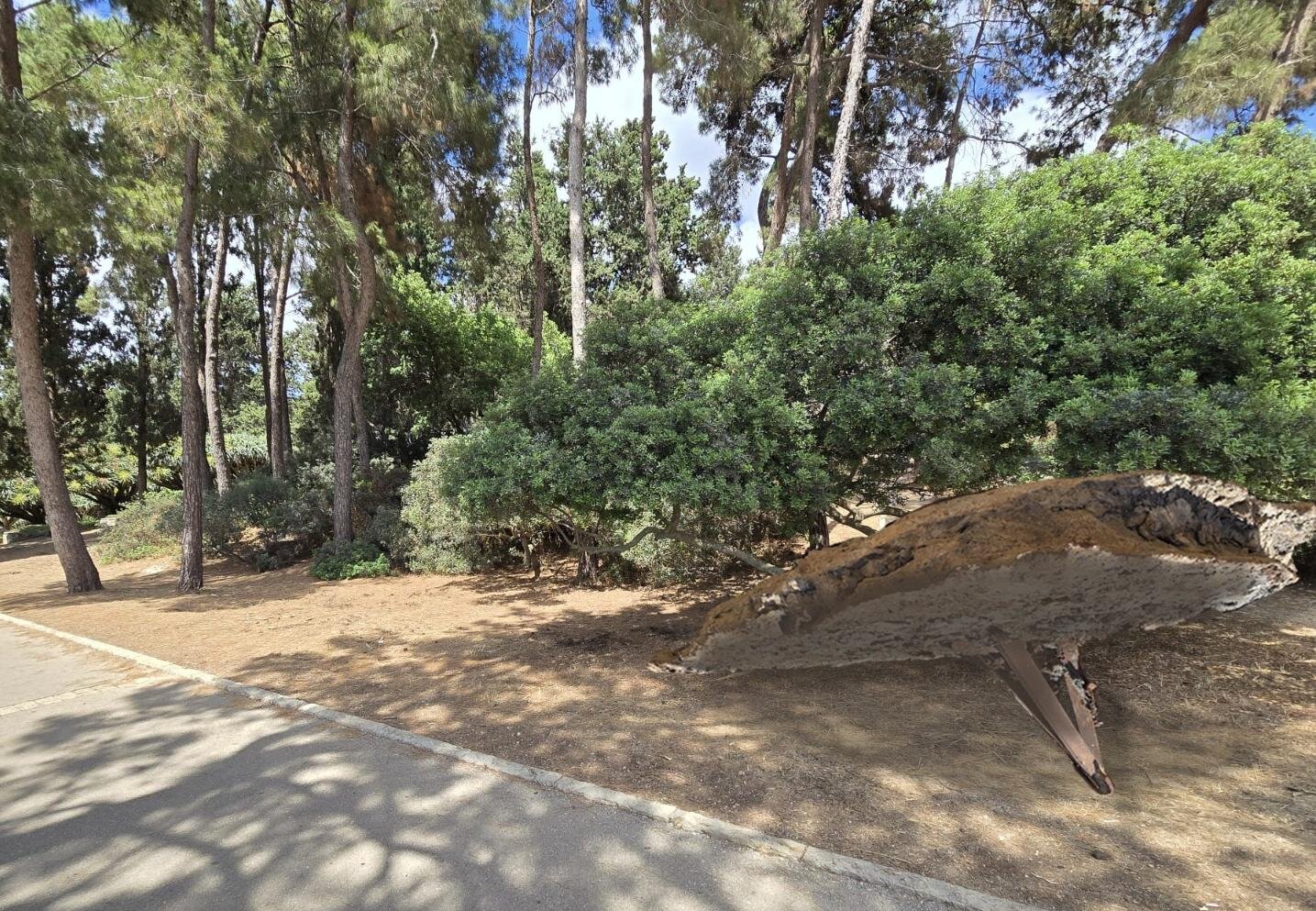
Shelter. Yaakov Dorchin

Yaakov Dorchin

Shelter, 2020

Bronze, H. 80 cm  × diameter 4 meter 

Shelter seems to have grown among the trees and shrubs, as though it had risen from the earth itself. Dorchin creates a form that recalls an ancient relic or a natural structure, such as a tree trunk, a rock, or a piece of bark torn from the ground. It is precisely through this act of ripping away that the sculpture creates a space, however ephemeral or imagined, of .protection and introversion

Meet the Artist:
Yaakov Dorchin is a sculptor, recipient of the Israel Prize for Visual Arts, and Professor Emeritus at the University of Haifa. During the 1980s, he established himself as one of Israel’s leading sculptors. His works are displayed in numerous public and private collections in Israel and abroad, including the collections of the Israel Museum and the Tel Aviv Museum of Art. His sculptures are installed at institutions of higher education, the Knesset, and in public spaces throughout Israel.

משה רואס הדמיה(1)
Relevé. Moshe Roas

Moshe Roas

Relevé, 2026

Bronze
H. 365 × W. 160 × D. 250 cm

The sculpture is constructed from a cast of a single palm branch, replicated and reassembled into a unified structure. Repetition, rotation, and displacement of the same module create a form in perpetual motion, growing, rising, bending, and balancing.

Meet the Artist:
Moshe Roas is a sculptor based in Tel Aviv. His works explore processes of transformation and transmutation through matter, form, and the dynamics of balance and material memory. Through acts of collecting, making, and assembling, he investigates how touch, time, and place become embedded in physical form.

Roas combines traditional craft techniques with found objects to create abstract sculptures that evoke skeletal, organic, and architectural structures. His work originates in an ongoing engagement with materiality and with the ways objects carry traces of use, history, and cultural memory.

Roas studied at Shenkar College of Engineering, Design and Art and at Hamidrasha School of Art. He has further developed his artistic practice through artist residencies and advanced studies in Israel and abroad. He teaches printmaking and serves as Director of the Print Workshop at the Petach Tikva Museum of Art. In 2026, he was awarded the Keshet Prize for Contemporary Art.

His work has been exhibited in museums, galleries, and exhibitions in Israel and around the world, and is held in major public and private collections, including the Tel Aviv Museum of Art. Roas is represented by Sommer Contemporary Art Gallery, Tel Aviv.

דב-פייגין-aspect-ratio-x
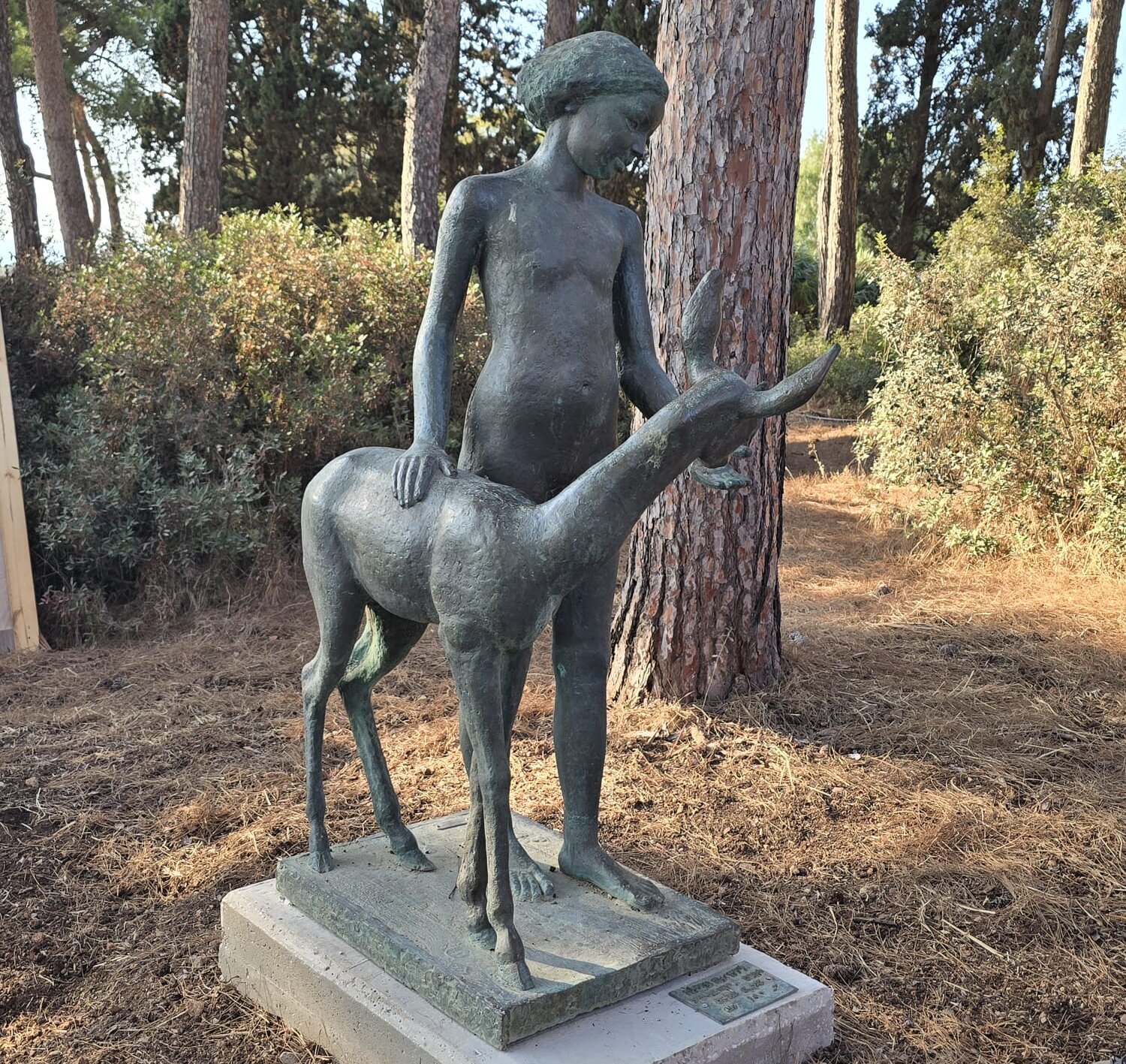
Girl and Doe. Dov Feigin

Dov Feigin
Girl and Doe, 1944-5

Bronze

  1. 150, W. 50, D. 100 cm

The sculpture depicts a young girl offering food to a doe. The girl and the animal engage in a silent dialogue, and their relaxed body language attests to the connection between them. The doe’s gaze is directed at the girl’s outstretched hand. The sculpture belongs to Feigin’s early body of work.

Meet the Artist

Dov Feigin was an Israeli sculptor born in Russia. He immigrated to Palestine in 1927 and joined Kibbutz Afikim, from which he later departed to study sculpture at the École des arts décoratifs in Paris. Upon returning, Feigin became a member of the Israel Painters and Sculptors Association, and his works were exhibited widely.

Feigin’s early work was influenced by Canaanite art as well as by modernism. Over time, his practice evolved from the figurative to the abstract. He was a founding member of the New Horizons (Ofakim Hadashim) group, a collective of artists active during Israel’s early years that sought to promote the influence of international modern art on Israeli visual art.

עדן בנט1
Road Fossil. Eden Bannet

Eden Bannet

Road Fossil, 2026

Tire imprint, sand, polymer plaster, fiberglass fibers
Dimensions Variable


Eden Bannet’s sculpture Road Fossil resembles a fossil, or perhaps a cluster of fossils. In paleontology, the study of ancient life mainly through fossils, one branch focuses on so-called trace fossils: preserved evidence of movement, such as footprints, trails, and other impressions left behind by living organisms. While an object is considered a fossil only if it is at least 10,000 years old, Road Fossil paradoxically attempts to fossilize the imperceptible flow of momentary “real time” by a concrete cast of a tire track impressed in sand.

The sculpture captures a moment that is inherently transient – perhaps even insignificant: an incidental mechanical movement from the present. Oscillating between sculpture and trace, the work inhabits the boundary between nature and infrastructure, heaviness and lightness, and between an everyday momentary action and the desire to preserve, perpetuate, and leave a lasting mark.

Meet the Artist

Eden Bannet works across sculpture, installation, photography, and painting, exploring the relationships between material, body, space, and memory. Through processes of dismantling, construction, and translation, she investigates how materials and images carry personal and cultural meanings.

A multidisciplinary artist based in Tel Aviv-Jaffa, Bannet graduated from the Department of Fine Arts at the Bezalel Academy of Arts and Design, where she also participated in a student-exchange program at the Slade School of Fine Art in London. Her work has been exhibited in galleries and museums in Israel and abroad. She has received numerous awards, including the Artistic Encouragement Award, a Plumas Art Foundation Grant, and an Artport Artist Residency. Her works are held in major public and private collections, including the Schocken Collection, the Tel Aviv Museum of Art, the Haifa Museum of Art, and private collections.

זוהר גוטסמן1
Tyche Fortuna of the Ruins. Zohar Gotesman

Zohar Gotesman

Tyche Fortuna of the Ruins, 2025

Marble, limestone, vegetation

  1. 32 × W. 40 × D. 27 cm

The figure of Tyche Fortuna, the Roman goddess of fate and good fortune, sits atop a mound of ruins, resembling the relics of a city and its civilization. Her crown, the globe, and a gubernaculum – symbols of power, dominion, and the ability to control destiny – lie at her feet. The figure of the goddess, associated with the arbitrary and unpredictable power of fortune, appears here in a moment of collapse: the symbols representing her authority and dominion over the world have lost their status and are thrown at her feet. Thus, the classical image of Fortuna has been transformed into an ironic reflection on the transience of power, rule, and culture, and on the possibility that even the most stable and magnificent of orders are ultimately at the mercy of fate.

זוהר-גוטסמן-aspect-ratio-x
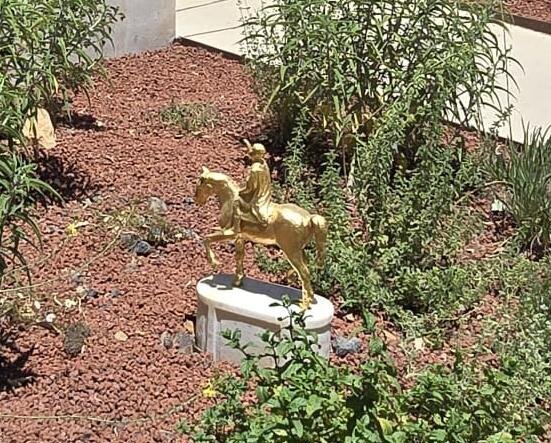
The Little Ruler. Zohar Gotesman

The Little Ruler, 2021

Jesmonite, gold, marble, vegetation

  1. 52 X W. 22 X D.14 cm

Gotesman’s sculpture depicts a ruler riding his horse, reminiscent of the familiar genre of monumental equestrian statues erected in squares and public spaces all over Europe. Throughout history, the equestrian statue has served to glorify power, authority, heroism, and victory, and to create an idealized image of the leader in the public sphere. In Gottesman’s work, however, the monument has been miniaturized, undermining the aura and sense of power associated with it. The reduced scale transforms the image of the ruler into an almost minuscule and anecdotal object, creating a disconnect between the image’s pretensions and its actual dimensions. Thus, the monument is transformed from a gesture of admiration into an object imbued with ridicule and sarcasm.

Meet the Artist

Zohar Gotesman is a sculptor and a graduate of the Department of Fine Arts at Bezalel Academy of Arts and Design, Jerusalem. He holds a bachelor’s degree in archaeology and art history from Ben-Gurion University. Gottesman specialized in traditional marble sculpting techniques in Carrara, Italy.

His works have been exhibited in numerous exhibitions in museums, galleries, and public spaces in Israel and around the world. Gottesman has received various awards and grants, including the Young Artist Award from the Ministry of Culture and Sport, the America-Israel Cultural Foundation Scholarship, the Outset Grant for Contemporary Artists (2017/2022), the Pais Award for Visual Arts (2017/2018/2022), and the Independent Creators Grant.

He is also a lecturer at Bezalel Academy of Arts and Design and at the School of Multidisciplinary Art in Shenkar College.

Of further interest...

Accessibility

Physically Disabled in the Gardens

Many trails traverse the Memorial Gardens. We recommend this route, but you
can choose to walk another route.

For further information >>

Sustainability

Sustainable Gardening

Sustainable gardening is defined as gardening that considers the needs of the current generation without harming the needs of future generations. It includes garden design that considers the existing elements on site – the landscape, soil, environment and vegetation suitable for the region

For further information >>

Dining Here

Dining-The Picnic Site

The picnic area is located near the secondary parking lot. You are welcome to spend time there before or after your tour of the Gardens.

For further information >>