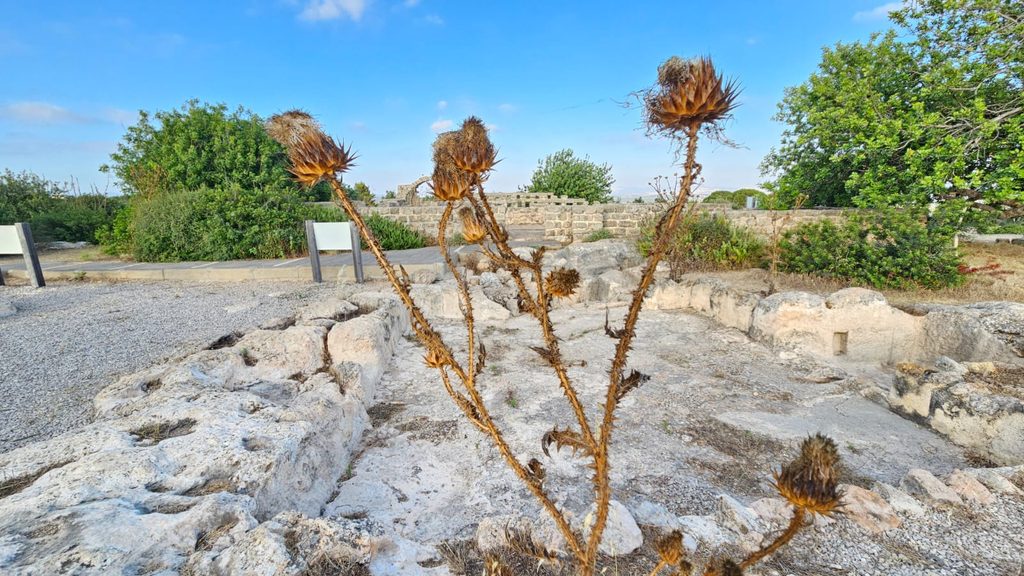
It is a hot Israeli summer month, and along the edge of the road and sidewalk, a yellowing milk thistle towers a head above the average person, as though surveying its surroundings. Beneath it stand the two of us, having stumbled upon an unexpected encounter with the wild creatures of Israel’s untamed, marginal, abandoned spaces: a scree of stones and exposed earth left behind by quarrying into the mountain, dry grasses, and construction debris. It is precisely there, in a place free from deliberate human management, that this wild creature, the thorn, can grow. And here, too, it can begin to emerge as an idea, as fertile ground for the social imagination.
Thorny plants are part of what is known as “ruderal vegetation” or “pioneer vegetation.” The term “ruderal,” originating in urban ecology, derives from the Latin rudus, meaning rubble. It describes plant communities that are the first to grow, spontaneously, in disturbed environments considered hostile: “cracks in sidewalks, areas along railway lines and roads, industrial sites, waste grounds or wastelands” (Stoetzer, 2018: 297).
In more temperate climates than Israel’s, these include plants such as dandelions and shepherd’s purse. In Israel, they are the thorns, adapted to the local heat and aridity, alongside plants such as shepherd’s purse, groundsel, mustard, and crown daisy. Their ability to take hold in nutrient-poor soil through deep root systems, deter herbivores with their spikes, disperse seeds, root in exposed soil, and provide food for pollinators enables them to thrive where other plants struggle.
The essence of this category (pioneer status, ruderal nature) lies in its primacy—plants capable of generating life, and rapidly, in impoverished liminal spaces, amid the excesses of human activity—along roadsides or at the margins of agricultural fields, in dumping grounds for surplus dirt and construction waste, or in land saturated with agricultural chemicals. There is a certain magic inherent in this “thorniness” and marginality: wildness and unruliness, growth despite and in defiance of circumstances, something emerging from nothing. It sparks our imagination and invites us to extend the metaphor beyond the botanical realm into the human one. While we are generally accustomed to the “humanization” of nonhuman agents, here we see the reverse: the “botanization” of the human world.
MIT anthropologist Bettina Stoetzer borrows the term “ruderal” (which in Hebrew can be rendered as tzimhei ma’azavot, literally “plants of abandoned places”) and uses it as a lens to consider how humans, plants, and infrastructures organize themselves together at the urban margins and within spaces of neglect, non-belonging, and disturbance. This lens allows us to see not only which plants grow among the ruins, but what forms of dialectical human–nature life, emerging through the interplay between the human and the nonhuman, become possible within them.
Another lens through which we can contemplate the wonders of the thorn—its primacy, its resilience, and metaphorical stature—is the Anthropocene lens. The Anthropocene, the Human Age, is the term commonly used to describe the geological era in which we live, during which human activity has become the dominant force shaping landscapes and natural systems on a geological scale (Crutzen & Stoermer, 2000). Out of these conditions, influential environmental anthropologist Anna Tsing describes marginal vegetation as the “weeds of the Anthropocene”—entities that are not merely plants, but metaphors for those opportunistic organisms (plants, fungi, and animals) that exploit zones disturbed or destroyed by human infrastructure, industry, and the far-reaching effects of capitalism as a dominant economic system, spreading uncontrollably.
Hence, the thorn can also be described as an “Anthropocene weed,” an organism that evolved and existed long before humans, adapted to harsh environments, and now thrives in environments that human activity has rendered degraded, impoverished, and harsh. It assumes unique forms depending on the specific type of disturbance and the lack of management that follow in its wake (Tsing, 2017). In this sense, the thorn is not a surviving remnant of wild nature, but an opportunistic form of life taking root in a damaged world: one that succeeds in taking hold precisely along the unmanaged margins of paving, quarrying, abandonment, and drought, transforming them into habitat.
Against the backdrop of bleak climate forecasts, the ruderal and Anthropocene perspectives we adopt through the thorn challenge the assumption that “ruins and processes of destruction” mark the end of the story for biological and human systems in the era of climate crisis. Following Stoetzer, ruins are also a material and social substrate in which infrastructure, waste, barren land, humans, and plants reorganize themselves. We therefore propose viewing ruins not merely as harbingers of doom, but also as a “point of origin” for understanding the life being rewoven within the tangle of a damaged ecology (Stoetzer, 2018). That is, what the thorn may teach us is who the first agents will be to reassemble the world after destruction: seeds, pollinators, damaged infrastructure, and tenacious plants, whose powerful biological mechanisms that give them an advantage under conditions of scarcity.
Following this, abandoned waste grounds can be seen as new spaces of organization that do not seek to return to their original, pure state, unlike abandoned spaces symbolizing human failure and neglect. As Caitlin DeSilvey suggested, we can observe these reorganizing spaces through a museological lens—“curated decay,” which acknowledges “historical significance without stopping the process” (DeSilvey, 2017: 7). Such curation is attentive to the processes of change, disintegration, and unexpected growth occurring within these spaces, allowing us to think of preservation not as the freezing of an existing state, but as accompanying a place as it opens itself up to new forms of life and matter.
Yet the lens of marginality, thorniness, and pioneer status offers no guarantee that life after human disturbance will be better, more just, or more diverse. In this sense, the thorn instead demonstrates what Anna Tsing calls “contaminated diversity,” defined as “collaborative adaptation to human-disturbed ecosystems” (Tsing, 2012: 95). In her discussion of Oregon forests suffering from industrial logging, Tsing shows how both the forest and the community of mushroom foragers gathered around it bear histories of human disturbance: the forest carries the memory of industrial logging, while many of the mushroom pickers are war survivors, refugees, and immigrants pushed to the margins of society (Tsing, 2015: 18–19).
Here, the metaphor of “ruderal spaces” is extended into the human realm, taking concrete form in alien species, both human and nonhuman, that thrive in disturbed environments.
In another article, Tsing describes nature’s return to the wild following disturbance as an “ambivalent future” (Tsing, 2017). The same thorn that manages to overcome harsh living conditions and nourish pollinators is also an aggressive plant capable of crowding out other species and harming ecological diversity, even as it stabilizes the soil and prepares it for the next cycle of life. As Stoetzer argues: “These practices are neither simple, joyful survival within ruins, nor are they free from power relations” (Stoetzer, 2018: 317). The thorn challenges the language of “partnership” that we seek to place at the center: a shift away from automatic management driven by an aversion to ruderal plants, toward relational, attentive, and adaptive management that recognizes the capacity of life to reorganize itself amid conditions of disturbance, neglect, and destruction—conditions that we ourselves have created.
In conclusion, the manicured landscape we perceive as “natural” is in fact the product of constant investment and management. Focusing on ruderal vegetation reveals just how much work and energy humans expend to create the appearance of the permanent, stable, and consistent environment with which we are familiar:
“Humans tend to try to manage things: land, buildings, even rivers. We invest enormous amounts of time, energy, and resources in imposing our will on nature, on existing or inherited structures, dreaming of permanent solutions, of monuments to our aspirations and dreams. But in periods of slackening, decline, or collapse, our capacities are no longer sufficient for all this management” (Callenbach, in DeSilvey, 2017: 16).
We propose the ruderal lens as a new perspective on the present era, asking whether the changes taking place in the landscape might be understood not only as loss, but also as a “release into unexpected and open states” (DeSilvey, 2017). That is, rather than focusing our efforts on returning the landscape to its previous state, ruderalism allows us to explore how we might live with change that is happening anyway. In this sense, the thorn can be thought of as an invitation to move beyond the classical conception of “conservation” toward one of “curated decay”: an attentiveness to processes of disintegration, release, and reorganization, without constantly attempting to resist them or erase their tracks.
References
Crutzen, P. J., & Stoermer, E. F. (2000). “The ‘Anthropocene.’” Global Change Newsletter, 41, 17–18.
DeSilvey, C. (2017). Curated Decay: Heritage Beyond Saving. Minneapolis: University of Minnesota Press.
Stoetzer, B. (2018). “Ruderal Ecologies: Rethinking Nature, Migration, and the Urban Landscape in Berlin.” Cultural Anthropology, 33(2), 295–323. doi:10.14506/ca33.2.09.
Tsing, A. L. (2012). “Contaminated Diversity in ‘Slow Disturbance’: Potential Collaborators for a Liveable Earth.” RCC Perspectives, 9, 95–97. doi:10.5282/rcc/6228.
Tsing, A. L. (2015). The Mushroom at the End of the World: On the Possibility of Life in Capitalist Ruins. Princeton, NJ: Princeton University Press.
Tsing, A. L. (2017). “The Buck, the Bull, and the Dream of the Stag: Some Unexpected Weeds of the Anthropocene.” Suomen Antropologi: Journal of the Finnish Anthropological Society, 42(1), 3–21.