It is hard to describe our first meeting. Within minutes, I felt as though we were picking up a conversation that had been interrupted years before.
Yaakov foraged most of the raw ingredients for the dishes he served in his restaurant himself. He was a walking encyclopedia of the edible wild plants of the Galilee.
“If you’re serious,” he said, “come tomorrow at five in the morning. We need to head out before it gets hot.”
By a quarter to five, I approached the entrance to the restaurant. Yaakov, of course, was already there. He poured us black Arabic coffee, deep and strong, followed by a small glass of Bethlehem Arak, sweet and fragrant with anise. Before we set off, he looked at me and asked, “Are you hungry?”
I nodded with slight embarassment.
He pulled out a warm pita, stuffed it with something that looked like young broccoli florets, squeezed a ripe tomato over them, and handed it to me. “We’re in a hurry,” he said. “We need to forage before the sun comes up. When the dew is still on the plants, they are full of life.”
I sat beside him. Before his old car even started moving, I took a big bite. For a moment, time seemed to stand still.
A deep, fresh, green flavor flooded my mouth: something between asparagus, spinach, and artichoke, yet also something entirely different—fleshy, slightly sweet, faintly lemony, and better than anything I had ever known.
“What is this?” I asked with a full mouth.
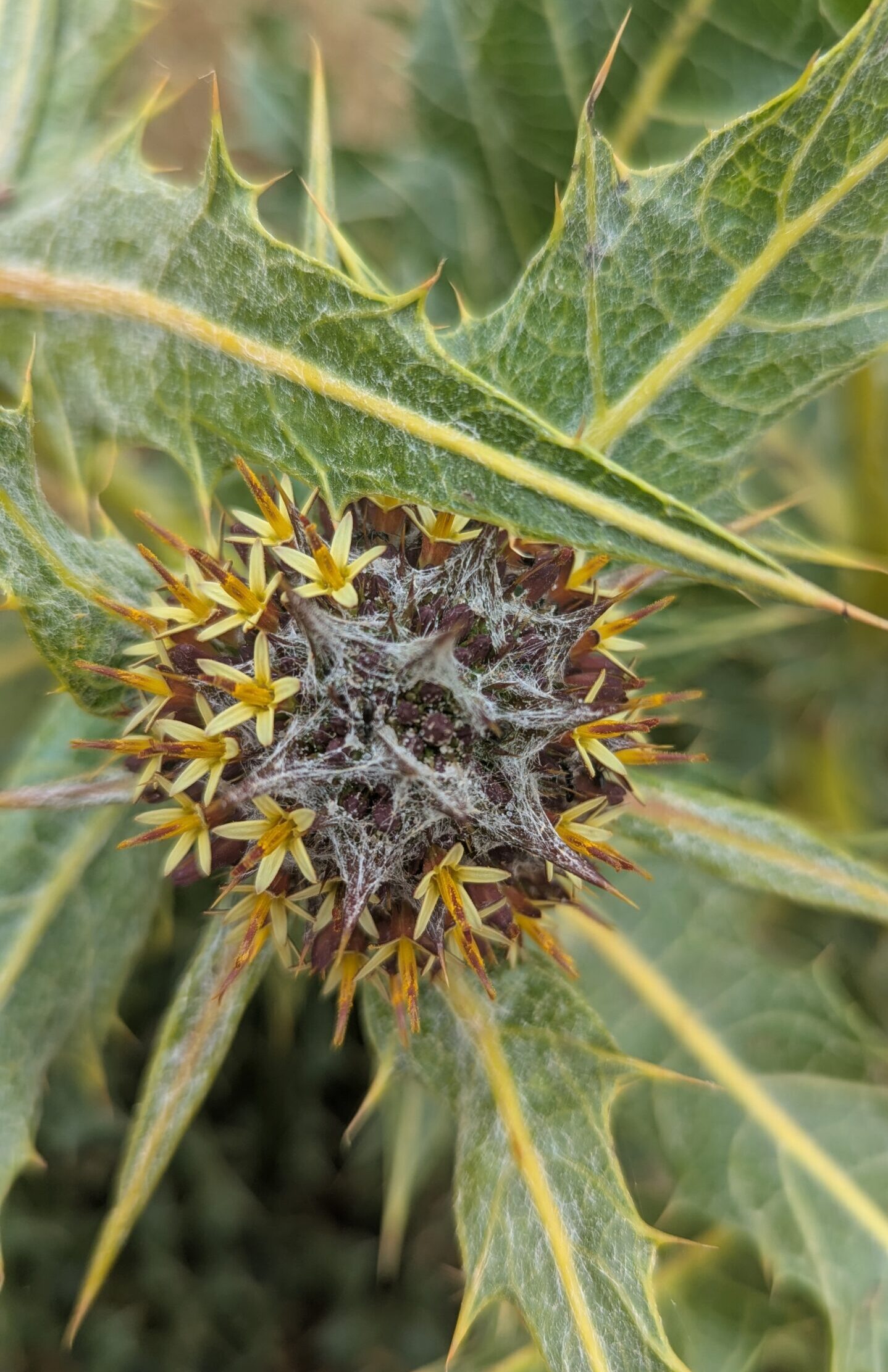
“Akkoub (Gundelia tournefortii),” he replied in his quiet voice, raspy from cigarettes.
Then he smiled and added, “It’s a protected plant, and you’re only allowed to forage a very small amount for personal use, or buy it from licensed private or agricultural growers.”*
At that moment, I understood that for Yaakov, and for generations of people who had lived here before him, thorns were never just plants; they were part of the season, part of the landscape, and part of memory.
Years later, I still think about that pita with akkoub. Not just because of its taste, but because of the question it left behind.
What is the connection between what nature produces in each season and what humans choose to eat during that same season?
Throughout most of history, humans ate primarily seasonal, local food, and human diet appears to have been closely tied to the cycles of nature and the seasons of the year. Winter was a season of storage and survival, with food based mainly on dry grains, stored legumes, cheeses, olive oil, dried fruit, and foods preserved in various ways to last through the cold months. Seasonal food also provides for the physiological needs of the human body in each season. Scientifically, however, such a causal relationship—the idea that nature produces what the human body needs in each season—has not been fully proven. Interestingly, although modern agriculture and globalization have weakened this connection to seasonal eating, studies show that people still tend to prefer certain foods at particular times of year, even when they are available year-round (for example, watermelon in summer and avocado in winter).
In Mediterranean regions such as Israel, the fields fill with fresh, young green plants in winter, following the rains. Alongside mallow, chicory, wild mustard, and wild asparagus, plants from the Asteraceae family also appear, such as akkoub, milk thistle, and wild artichoke. In their early stages, they form rosettes of tender, succulent leaves, but as spring progresses, some develop spiny flower heads.
The Asteraceae family is one of the largest plant families in the world, and many of its members share similar characteristics: they are rich in bitter compounds, polyphenols, and protective substances produced by the plant to cope with environmental conditions. Modern science is currently investigating these compounds in the context of the digestive system, metabolism, and various physiological processes.
Akkoub itself, which has become something of a symbol of local foraging cuisine, contains flavonoids, polyphenols, and various minerals. Studies conducted in recent years have found significant antioxidant activity, along with a wide range of bioactive compounds.
But prickly Asteraceae plants are only half the story. At precisely the same time, the fields also fill with non-prickly wild greens such as chicory, mustard, and mallow. If thorns bring bitterness, depth, and intensity, wild greens bring freshness, succulence, and the vitality of new growth. Thorns tend to be richer in bitter defensive compounds developed to protect the plant, while green wild plants tend to be richer in vitamins, chlorophyll, and readily available minerals.
The more I observe the landscape, the more convinced I become that the real question is not which is healthier—thorns or wild greens. Nature does not offer us a single ingredient with miraculous properties; it offers us an entire system. Thorns bring bitterness and fiber; the wild greens bring tenderness and nourishment. Together, they create the cuisine of spring.
What is particularly interesting is the bitterness. For thousands of years, bitter flavors were an integral part of the human diet. Today, we know that bitter compounds stimulate the secretion of digestive juices and bile, affecting various mechanisms in the digestive tract. This may be one reason why cultures across a vast geographic range, from the Mediterranean to Asia, developed traditions of eating bitter wild plants specifically in spring.
I do not know whether summer vegetation, wild greens, and especially thorns are plants that “cleanse” the body. Some believe that the idea of a spring detox is an attempt to recast an ancient tradition in modern terms. But I do know that for thousands of years, at precisely the moment when winter ended and people returned to the fields, the thorns and the year’s first wild greens were there waiting for them.
Perhaps thorns are not medicine; perhaps they are memory. A memory of a time when people did not read the seasons on a calendar, but ate them.
And when the akkoub and the first wild greens broke through the earth, they knew that winter was over.
*Foraging Akkoub is strictly prohibited in nature reserves and national parks.
Traditional Akkoub Salad
Editor’s Note: Akkoub is a protected species in Israel and foraging it from the wild is prohibited, except in very small quantities for personal use. This recipe is presented as part of a longstanding local culinary tradition.
Ingredients
- Young, cleaned akkoub (from a legal, authorized source)
- White onion
- Ripe tomatoes
- Green onions
- Olive oil
- Lemon juice
- Salt
Preparation
- Blanch the akkoub in boiling water until tender, then drain.
- Coarsely chop and sauté in a pan with olive oil and chopped white onion until lightly browned.
- Combine with fresh tomato juice and coarsely chopped green onions.
- Season with olive oil, a little lemon juice, and salt.
- Serve at room temperature alongside fresh, warm pita.