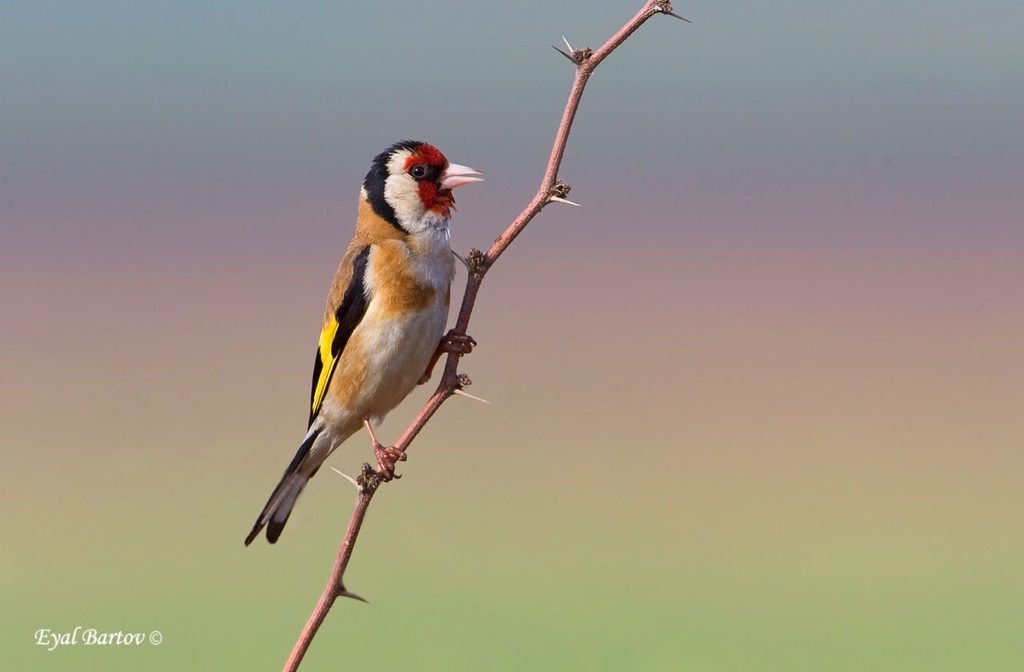
In the Israeli summer, when the air stands still, the green grass has turned yellow, and the soil has cracked, thorny plants stand out along the edges of paths, though most of us make an effort to avoid them. We regard them as a nuisance: they catch on our pants, prick our legs, and take over fields. But if we stop for a moment to look, and if we are also a bit lucky, we may discover that these thorns have a regular visitor well worth seeing.
The European goldfinch (Carduelis carduelis) is a songbird belonging to the finch family (Fringillidae), widespread across Europe, North Africa, and Central and Western Asia. In Israel, it is a resident bird commonly found in the Mediterranean region and the northern Negev. It inhabits a variety of open habitats with herbaceous vegetation rich in seeds, including batha scrublands, fallow fields, forest edges, agricultural areas, and parks.
What distinguishes the goldfinch is its specialized diet. Among finches, bill structure is closely linked to feeding strategy, and the goldfinch is clearly adapted to extracting small seeds concealed within spiny flower heads. This adaptation allows it to exploit a food source inaccessible to most other bird species. In other words, what constitutes a hard-to-reach food source for most animals is an open pantry for the goldfinch.
It is precisely from this trait that the goldfinch derives its Hebrew name, hohit. The Hebrew term hoah can be confusing, as in Hebrew it serves both as the name of the genus Scolymus and as a collective term for various thorny plants. The genus includes only three species, two of which grow wild in Israel: the spotted golden thistle (Scolymus maculatus) and the common golden thistle (Scolymus hispanicus). In popular usage and literature, however, hoah also refers to other species of thistles, and the goldfinch actually feeds on a wide range of thorny plants in the daisy family (Asteraceae).
Milk thistle (Silybum marianum), Syrian thistle (Notobasis syriaca), and the two Scolymus species found in Israel form a significant portion of the goldfinch’s diet, particularly from late summer through winter. Glück (1986) demonstrated that goldfinches prefer seeds with a high energy content and invest considerable time in extracting them from spiny flower heads, even though they are more difficult to access than exposed seeds. Additional research showed that the distribution of flower heads across an area affects both flock size and the birds’ foraging patterns.
The relationship between thistles and the goldfinch is an interesting example of the interaction between a plant and a seed-eating bird. Thorns and spines are considered an evolutionary adaptation developed in response to grazing pressure from herbivores: they make eating difficult, thereby reducing the risk of the plant being consumed. The goldfinch does not feed on the leaves or stems, but nimbly extracts seeds from the plant’s flower head with its slender, conical beak, sometimes even hanging from swaying stems in intricate positions to reach them. The thorns protect the plant from herbivores but do not prevent the goldfinch from reaching its seeds. From the bird’s perspective, what keeps others away effectively safeguards the food for itself.
A review by Holland et al. on bird diets in European agricultural fields highlighted the importance of Asteraceae thistles as a food source for seed-eating birds. The researchers showed that preserving field margins, scrublands, and uncultivated areas can increase year-round seed availability, thereby helping conserve populations of species that depend on them. In Israel as well, evidence shows that landscape changes affect the goldfinch. Yom-Tov reported a decline in the populations of several bird species breeding in Israel over the past century, including the goldfinch, as a result of changes in land use, urbanization, and the loss of open habitats. In the past the goldfinch was very common in Israel. One hypothesis for its decline is the loss of fallow fields and thorny vegetation due to development pressures, alongside other factors such as nest poaching by jays, afforestation, and habitat fragmentation. Compounding habitat loss is the threat of illegal trapping. In Israel, goldfinches are still trapped for trade and kept as caged songbirds. This phenomenon is widespread in other parts of the Middle East and North Africa as well. In Algeria, for example, Mezhoud et al. described a dramatic decline in goldfinch populations as a result of the illegal trapping of millions of birds, bringing the goldfinch to rare-species status in its natural habitats.
The story of the goldfinch illustrates the importance of features in the landscape that are often perceived as marginal. Thorny plants—including Scolymus, milk thistles, and Syrian thistles—provide food at a time when other resources are dwindling, thereby supporting a wide range of wildlife. When we “tidy up” the landscape by carefully mowing roadsides, we remove not only the thorns but also a vital food source for goldfinches and other animals that feed on these plants. The thorn, seemingly useless, reveals itself as a protector, a storehouse of seeds, and a habitat; the small, delicate goldfinch reveals the hidden value of the thorn, reminding us that what may seem like nothing more than a weed or a nuisance can, at times, be essential to sustaining life.
References
Yom-Tov, Y. (2018). Forecast for Israel’s fauna in 2040. Ecology & Environment, 9(2). (In Hebrew).
Miroz, A., Wein, G., Levinger, Z., Steinitz, O., Hatzofe, O., Haviv, E., Perlman, Y., Alon, D., & Leader, N. (2017). The Red Book of Birds in Israel. Society for the Protection of Nature in Israel and Israel Nature and Parks Authority. (In Hebrew).
Glück, E. (1985). Seed preference and energy intake of Goldfinches Carduelis carduelis in the breeding season. Ibis, 127(4), 421–429.
Glück, E. (1986). Flock size and habitat-dependent food and energy intake of foraging Goldfinches. Oecologia, 71(1), 149–155.
Holland, J. M., Hutchison, M. A. S., Smith, B., & Aebischer, N. J. (2006). A review of invertebrates and seed‐bearing plants as food for farmland birds in Europe. Annals of Applied Biology, 148(1), 49–71.
Mezhoud, B., Djemadi, I., Bakhouche, B., Djendli, M., Daas, H., Moussouni, A., Saadi, A., & Draidi, K. (2026). European goldfinch (Carduelis carduelis) in Algeria: Socio-ecological status and conservation challenges of a species on the brink. Applied Ecology and Environmental Research, 24(3), 5553–5564.
Newton, I. (1967). The adaptive radiation and feeding ecology of some British finches. Ibis, 109(1), 33–96.