In “Lament for Adonis,” composed by the Greek poet Bion of Smyrna, the goddess Aphrodite (Cypris), upon hearing that her beloved Adonis has been wounded, runs barefoot in a frenzy through the forest thicket, dense with thorny bushes. The thorns pierce her delicate skin, and her blood, dripping from them, stains the roses red, transforming them into a symbol of passion and pain.
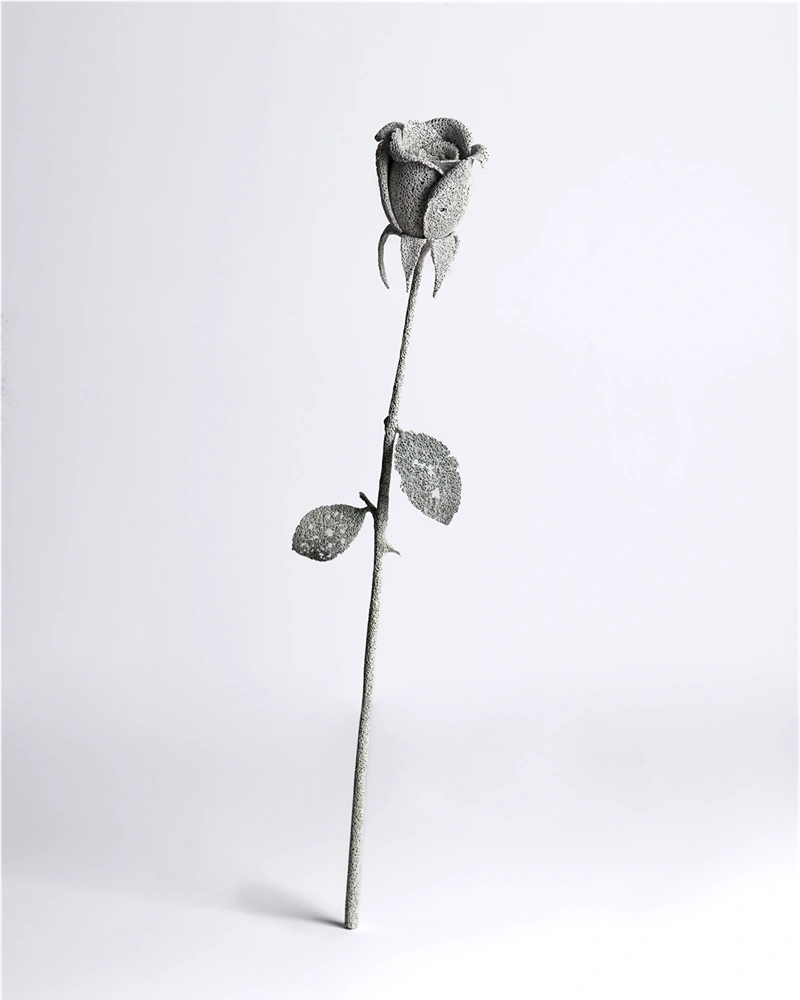
From a block of aerated concrete, a technical material used to construct walls and enclosures, sculptor Haimi Fenichel virtuosically carved a flower—a rose. In a single sculpture, Fenichel thus brought together two seemingly disparate things: a course building material and the quintessential romantic image, the rose. Carving into the rough block revealed the beautiful rose within, momentarily transforming romance into a foundational material—something from which things are built.
Photography: Meidad Suchowolski
The roses we buy for a loved one are handed to us with their thorns removed, as though to banish from our minds the possibility of hurt and the pain of love, and to present the gesture of love as safe, smooth, and free of danger—a metaphor for the fantasy of love and happiness without pain. Yet the single thorn remaining on Fenichel’s romantic sculpture deconstructs this fantasy. The work’s title, “Passive-Aggressive,” delivers another prick to this enchantment, also hinting at a cynical stance. Fenichel shares that he worked on the sculpture in the aftermath of heartbreak and a difficult breakup, and that the work emerged from a critical stance toward the poetics of love.
The rose’s thorn, which in Fenichel’s work can be seen as a “moment of disillusionment,” does more than merely puncture the fantasy. The thorn is, in fact, also the rose’s means of protection. Perhaps for this reason, it can be read not only as a threat to love, but also as a guardian—a small, sharp shield protecting something vulnerable and tender. On the stem of the romantic rose remains a reminder that the possibility of being hurt is not necessarily the opposite of love, but rather part of what calls forth tenderness, imparts meaning, and allows love to exist.